
I’m standing in a fitting room trying on the bag that will carry my business for the next few years, and I keep forgetting to look at the leather. The strap. The weight. Because the mirror is doing its thing — of course it looks good on me — and that’s exactly the problem with buying a work bag. The photo in your head is a bag on your shoulder in a city street. The reality is the same bag on the back seat of your car, on the floor of a cafe, on the table of a meeting where someone’s about to sign something.
Your bag does the morning school drop-off at 8, carries the laptop into a pitch at 11, and still has to look like it belongs at the table when you sit down to sign something at 4. Most bags are built for one of those jobs, not all three. So here’s how I choose one that can do the whole day — not just the part that photographs well for LinkedIn.
The actual job description
Before I look at a single bag, I write down what goes in mine on an ordinary Tuesday. For most women running their own business it’s a laptop, a notebook (I still prefer paper to a screen, and I’m not sorry), keys, a phone, a charger — and then whatever the morning has handed me: a packed lunch, a spare sweater, a signed form that needed my signature an hour ago. That’s not a handbag’s job. It’s not a briefcase’s job either. It’s both at once, and it has to look right across a meeting table an hour after it was in the car seat. That’s the actual brief.
Anything that can’t hold all of that and still sit next to a client without apologising for itself isn’t doing its job.
Structure matters more than you’d think
A bag that holds its shape looks professional the second you put it down. On camera, across a table, propped against a chair leg in a meeting — it sits upright, keeps its silhouette whether it’s full or half-empty, and looks the same at 9am as it does at 6pm.
A slouchy, unstructured bag does the opposite. It collapses in on itself, swallows whatever’s inside, and by the afternoon it’s slumped against your leg looking like you’ve been carrying it since university. Soft bags feel relaxed in the shop. On a working day, with a laptop in them, that softness just looks tired.
The leather question, in plain terms
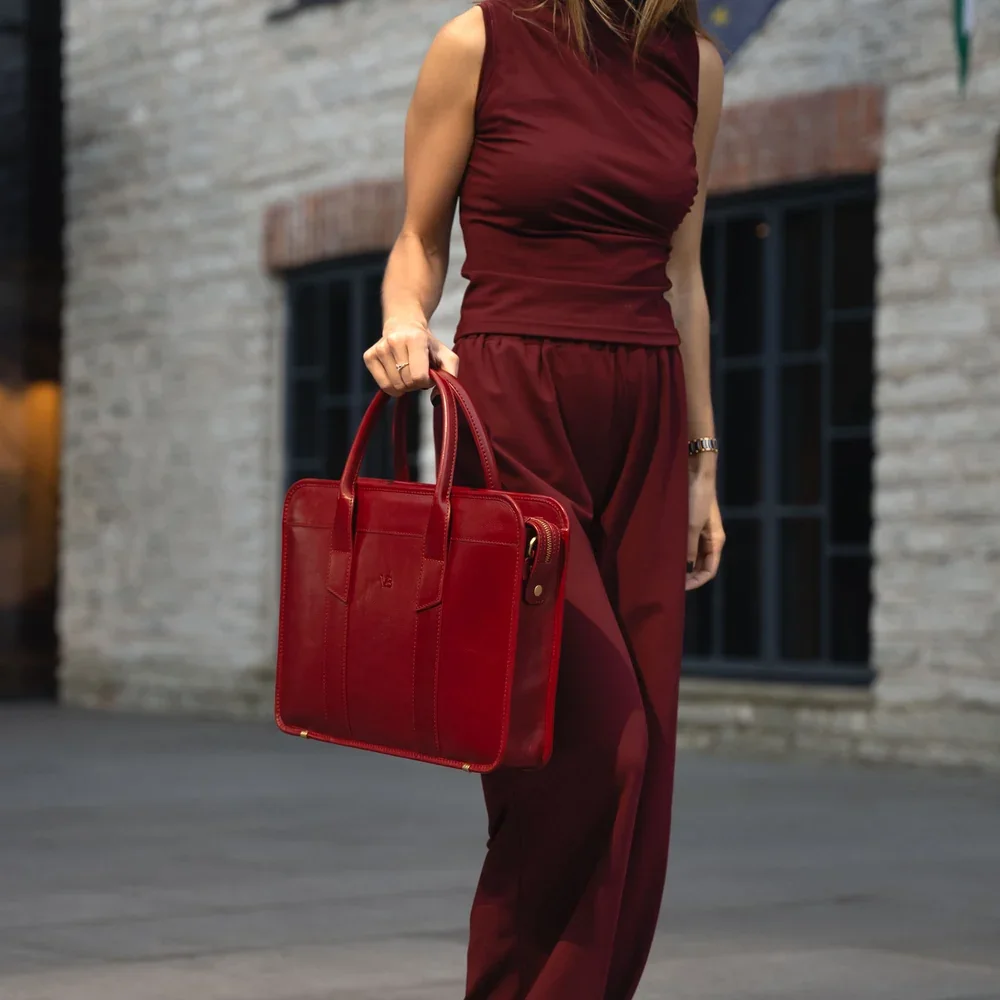
Leather grading is confusing on purpose. Full-grain leather is the top layer of the hide, left intact — the strongest, densest part, and the one that ages well, taking on a little character instead of falling apart.
“Genuine leather” sounds like a guarantee, but it isn’t one. It’s the lower grade, made from layers further down the hide that have been sanded and coated to look uniform. It’s real leather, technically — just the weakest kind still sold under the name.
The difference shows up exactly where you’d expect: on the bottom corners that get put down on cafe floors, station platforms and car seats, day after day, for years. Full-grain shrugs that off. “Genuine” leather thins, cracks, and starts looking tired within a year or two of exactly that treatment.
The weight you’ll actually carry
The bag is on your shoulder all day, usually over a coat. An overbuilt bag — lots of structure, heavy hardware, thick leather throughout — adds real weight before you’ve put a single thing inside it. And once the laptop and the rest go in, that weight is on your shoulder from the front door to the last meeting of the day.
Be honest with yourself here, rather than romantic about it. A beautifully structured bag you stop carrying because your shoulder aches by lunchtime is not solving your problem. Hold a laptop-weighted version in the shop, on one shoulder, for a few minutes — and pick the weight you’ll still be happy with in month six.
What needs to be inside
The outside gets all the attention, but the layout inside is what makes a bag work on a working day. A few things worth checking before anything else:
- A padded laptop sleeve — a dedicated, cushioned compartment, not just a slot between other things, so the laptop is protected and doesn’t scratch against your keys.
- A pocket the keys always live in — small, dedicated, ideally near the top, so you’re not tipping the whole bag out on a doorstep in the rain.
- Enough room that it closes properly when full — a bag that only zips shut when it’s half-empty will strain, gape, or stop closing within a few months of daily use.
- A place for the everyday small stuff — cards, a phone, a pen — that doesn’t involve digging past the laptop every time.
If a bag fails any one of these in the shop, it will fail it every single day you own it.
Buy once, or buy often?
There’s a real argument for one well-made bag instead of replacing a cheap one every year or two. On cheap bags the lining goes first — it frays around the zip, and once that starts, everything inside starts snagging on it. The straps stretch unevenly, the corners scuff through to a different colour underneath, and within a year it looks like something you’re using up rather than something you chose. One well-made bag, kept in good condition, is doing the same job three or four years from now, with a bit of that full-grain resilience working in your favour.
That said, buying once isn’t always the right call, and it’s worth saying so plainly. If your taste is still changing — you’re not sure yet what “your style” is, or you like switching bags with the seasons — a rotation of cheaper bags is the more sensible choice, not a compromise. The same is true in a messy season of life: small children who redecorate every bag they touch, a house move, a business that’s changing shape month to month. Buying one expensive bag to match a life that isn’t settled yet is a bad trade.
Buy once when the job the bag needs to do is stable. Buy cheap and often when your life isn’t — and don’t feel you need to apologise for that.
A bag I’d actually put on my desk
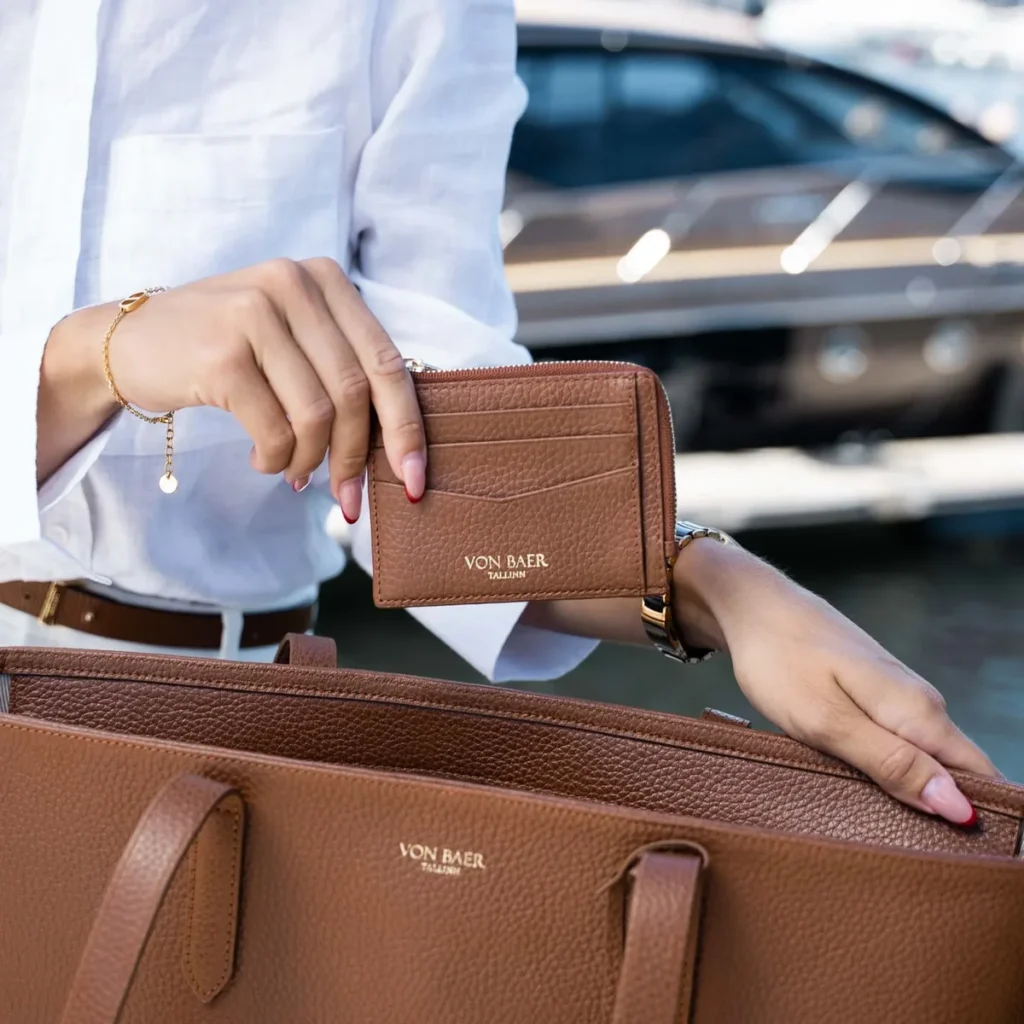
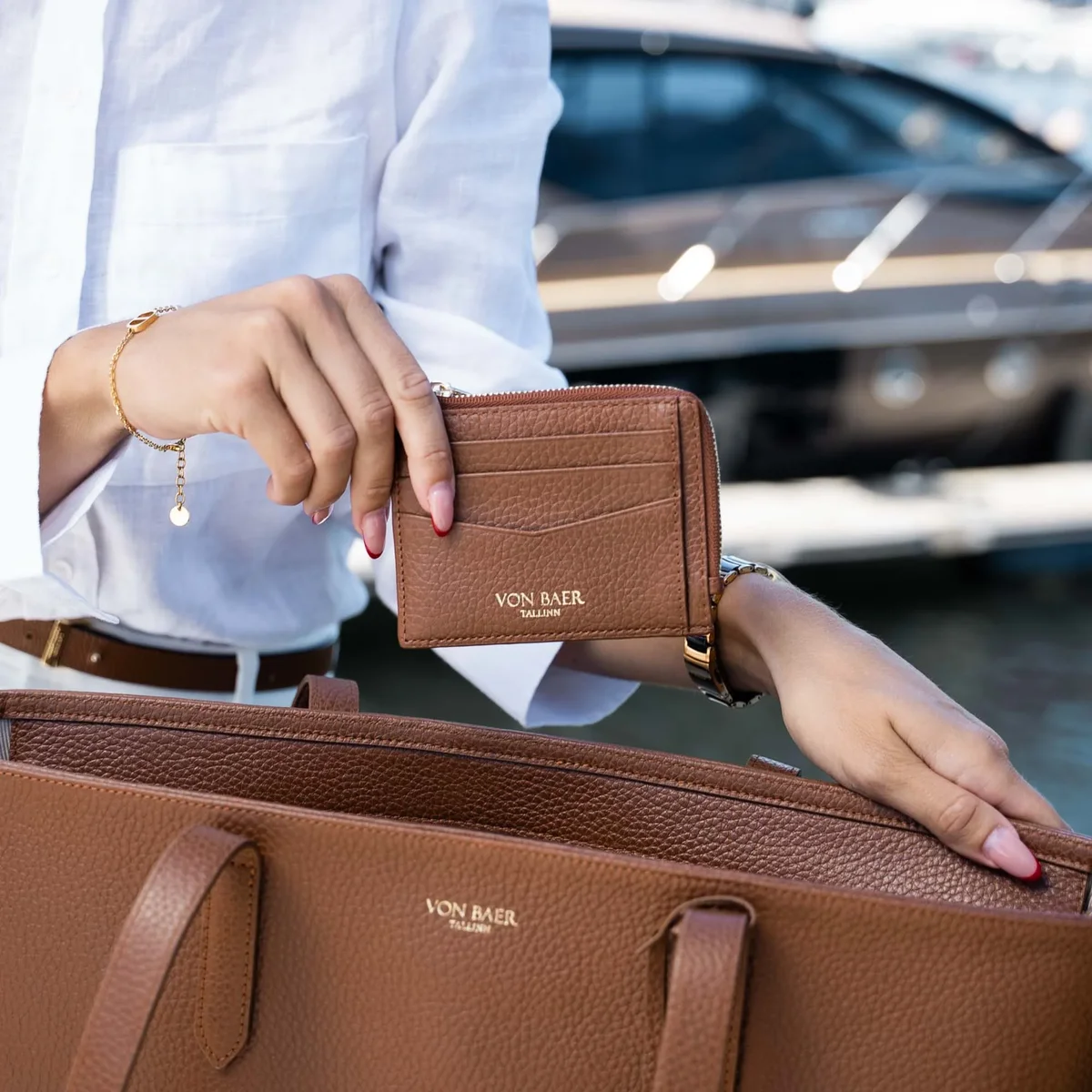
The shopping brief comes down to: structured, full-grain, room for a laptop and the rest of the day. The Elegance Leather Tote from Von Baer is the example I keep coming back to. Their bags are made from full-grain leather, cut from A-grade hides at the bend where the fibres sit densest and drum-dyed the whole way through — and every bag carries Von Baer’s 5-Year Limited Warranty.

These bags are premium-priced, and there’s no getting round that. If the checklist below matters more to you than the number on the tag, that’s the trade worth making.
Your five-line checklist
Screenshot this before you go shopping:
- Structure — it holds its shape standing on its own, empty or full.
- Grading — it’s full-grain leather, not “genuine leather.”
- Weight — it feels fine on one shoulder with a laptop already inside it.
- Layout — padded laptop sleeve, dedicated key pocket, closes properly when full.
- Fit for your life right now — buy once if your life is settled, buy cheap and often if it isn’t.
My one edit, in one line: the right bag isn’t the one that looks best on the rack, it’s the one that still looks right at 6pm when it’s full of your whole day.
FAQ
Do I really need full-grain leather? Not for every bag — but for the one that hits cafe floors and meeting tables daily, it’s the difference between a bag that ages and one that just gets older.
What if my life is chaotic right now? That’s the case for buying cheap and often. A rotation of sensible bags beats one investment bag during a move, a new business, or the toddler years.
How do I test the weight before buying? In the shop, on one shoulder, with something laptop-weight inside, for a few minutes. If it’s fine then, it’s fine in month six.
a note from Margot — I spent ten years editing magazine racks. Now I edit your closet. I bought my first “investment” work bag before my business had settled, and it sat unused while my life changed underneath it. This is my promise: edit the bag to the life you’re actually in, not the one on the tag.