

Daniel came back from his morning run and dropped a phrase on the kitchen table: “Some of the older types are just clocking out early.” He’s an architect, so half his world is now watching AI redraw what a career is worth. I didn’t push. That week, I did something I don’t do often — I actually read a research brief all the way through, and then I sat with it.
The short version: a July study from Boston College’s Center for Retirement Research found that workers in AI-exposed occupations are leaving work at higher rates than workers in low-exposure jobs. Not a cliff. A tilt. And the numbers, once you slow down with them, are uncomfortable enough to deserve a second look.

What the study actually found
The Center for Retirement Research was prompted by a Wall Street Journal piece on workers choosing retirement over learning to work with AI — because the layoffs in tech were visibly landing on older employees. Researchers took the Current Population Survey, the same dataset behind the monthly unemployment number, and followed workers 55 and up for a year. Then they scored each job’s AI exposure using Digital Planet’s metric, which measures the share of a job’s tasks that software like large language models can handle — not some vague “will AI take my job” hunch.
Why I like that scoping: high-exposure jobs, like web design or data science, are exactly the ones where AI could either replace the role or just quietly make the person sitting in it faster. The study found the second thing happening less than the first, for some groups.
The numbers, slowed way down
Here’s the part worth repeating twice, because it reads like a line item:
- Painters, exposure score of 5, barely shifted at all.
- Computer programmers, on the far end of the scale, saw exits from work jump by over 25 percent.
- Middle-exposure jobs sat somewhere in between, with increases landing between 9 and 16 percent.
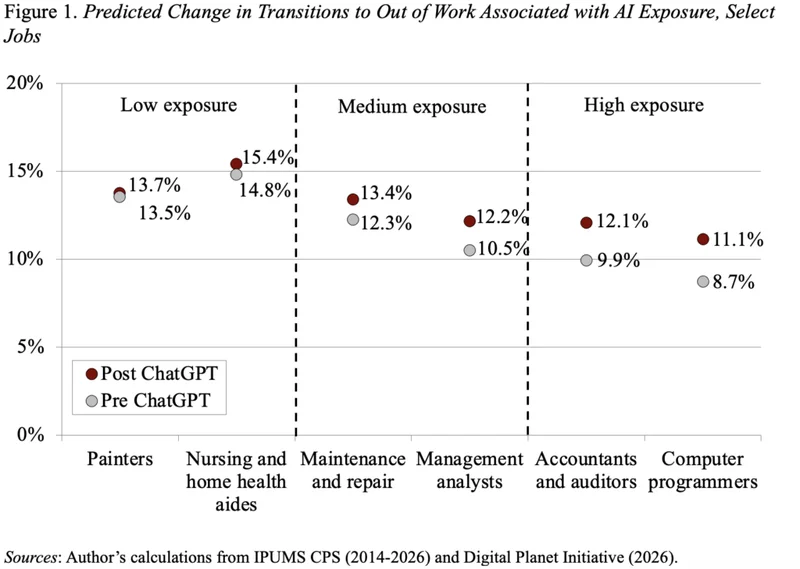
Why the paper goes to all this trouble separating high earners from low earners: it found bigger exits in the higher-paying, more-exposed jobs. That’s a reversal of the last automation wave, which crushed middle-income work first. The warning baked into that: people who assumed their salary was armor may be discovering, this quarter, that it was paper.
Why “a little earlier” hits harder this decade
This is where the AI story and the Social Security story collide, and it’s the part most headlines skip. The Social Security Trust Fund is projected to be depleted in 2032. If nothing changes, benefits for current and future beneficiaries drop by 22 percent in one go.
Do the honest arithmetic. If benefits are going down, careers can’t also be shorter. Something has to give, and right now the thing flexing is the person leaving at 61 because the work just feels different.
There’s also a political layer: every serious reform proposal on the table involves raising the retirement age, and the one I’m aware of would target the top 40 percent of earners — precisely the group the study says is most exposed to AI. The people the proposal assumes can work longer are the ones already leaving sooner. That tension is going to show up in the next few budget debates, and your retirement plan is inside it whether you’re eavesdropping or not.
The website editor, a small but honest story
Most of the brief uses a website editor as its running example, and I won’t pretend that’s a hypothetical. That was literally my job for ten years. The roughly-true version of what’s happening in rooms like mine:
- Grammar checks, fact pulls, first-draft padding — the parts of the job that used to fill a whole afternoon now fill a search bar.
- The parts that don’t — taste, knowing which idea to kill at 4:40 on a Friday, the phone call to the source who’s being mysterious — are the ones that survived the wave.
- The people who show up first to the tool and get good at it are doing the same job at a smaller team. The people who treat it like a rumor about the future are the ones quietly updating their CVs.
If your workplace has a “we’ll figure out what the tool replaces” phase, that phase is not hypothetical. Someone in your department is in it right now.
The Edit
AI is tilting earlier retirement for some jobs, not all of them — and the jobs at the top of the exposure chart are the ones feeling it first. If someone in your family is in a 55-and-up workplace that leans on writing, design, code, analysis, or craft, have the “what does earlier mean” conversation now, quietly, over dinner. The math of a shorter career no longer balances with the math of a shrunk check, and pretending otherwise means retirement planning happens at 63 instead of 52.
{{faq_start}}
Which jobs are most affected by AI exposure, according to the study?
Computer programmers saw exits jump by over 25 percent. Middle-exposure occupations saw increases between 9 and 16 percent. Groundskeepers, with an exposure score of 5, barely moved at all. Higher-paying, more-exposed roles are seeing the bigger shifts — a reversal of how past automation waves worked.
What happens to Social Security in 2032?
The Social Security Trust Fund is projected to be depleted in 2032. If no policy change is made, benefits for both current and future beneficiaries would be cut by 22 percent, which is precisely why “a little earlier” retirement doesn’t balance mathematically this decade.
Is this a “job apocalypse” for older workers?
Not the study’s finding. It’s a change in the rate of leaving work, concentrated in high-exposure occupations. Lower-exposure jobs barely moved at all. The pattern is uneven, and that unevenness is the story.
{{faq_end}}
A note from Margot
I’ve spent ten years on the other side of that editor’s desk. I’m not the one deciding who gets to keep working, but I’m the one who gets to tell my dad, “yeah, and here’s what’s actually happening,” without the fog. If you liked this piece of calm, the style-to-career archives and the capsule wardrobe guide hit the same nerve: fewer, better, less noise. Edit the career the same way you edit the closet.