
You’ve stared at a photo, squinted at your reflection in the bathroom mirror on the way out the door, and thought it: my nose looks too big. You’ve Googled rhinoplasty prices. Maybe you’re halfway to booking a surgical consultation. But here’s something I wish someone had told me sooner — your nose might not be the problem.
In most cases where people feel their nose is too prominent, the issue isn’t the nose itself. It’s what surrounds it. A recessed chin, flat cheeks, or a soft jawline creates an optical imbalance that makes the nose appear larger than it actually is. Fix the proportions and suddenly the nose fits.
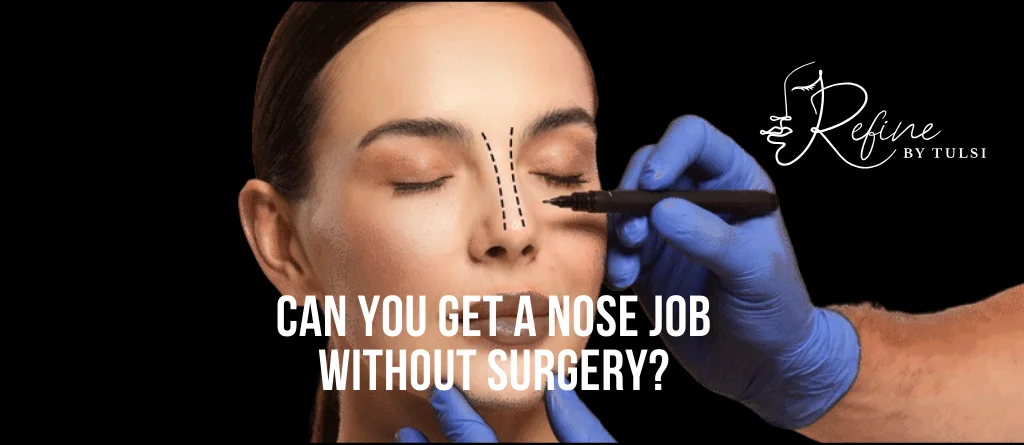
The Proportional Illusion
Your face isn’t read as isolated features. It’s a set of proportional relationships. When those are in balance, every feature looks harmonious — even if none is objectively perfect. When they’re off, the most prominent feature becomes the one you notice.
The nose sits at center stage — literally and perceptually. When the structures around it are underdeveloped, there’s nothing to counterbalance it:
- A recessed chin makes the nose appear to project more than it does. In profile, an ideal face follows a gentle line from forehead through nose to chin. When the chin falls behind that line, the nose looks like it’s pushing forward — even if it’s average-sized.
- Flat cheeks remove the lateral volume that frames the nose from the front. Without cheekbone presence, the nose dominates the midface. Restore that volume and the nose reads proportionally smaller.
- A weak jawline reduces structural definition in the lower face, shifting visual weight upward — straight to where the nose lives.
The Profile Test You Can Do at Home
Stand sideways in front of a mirror. Place your finger vertically from the tip of your nose straight down toward your chin. If there’s a noticeable gap between your finger and your chin, your chin is recessed. Now imagine pushing it forward to meet that line. Does your nose suddenly look more balanced? That’s exactly what chin filler does.
What Chin Filler Actually Does
I’ve always thought chin filler is the most underrated treatment in injectable aesthetics. A small amount of high G-prime filler — Voluma or Radiesse — placed precisely at the chin creates effects that ripple outward:
- Makes the nose appear smaller in profile by extending the lower facial line forward.
- Sharpens the jawline — chin projection extends the visual line of the jaw, creating a more defined lower face.
- Lengthens a short lower face, bringing vertical balance to the whole look.
- Softens the mentolabial fold — that crease between your lower lip and chin often improves without being directly treated.
- Improves the neck-chin angle, reducing the appearance of a double chin even without weight loss.
The treatment takes 15 minutes. Most people need 1–2 syringes. Results are immediate, with mild swelling for 24–48 hours. And the improvement lasts 12–18 months.
What Cheek Filler Adds
Cheek filler works from a different angle — literally. While chin filler corrects your profile (side view), cheek filler addresses frontal proportions and midface structure:
- Creates a wider frame around the nose. Prominent cheekbones make the nose appear proportionally smaller from the front.
- Lifts the entire lower face. Midface volume creates an upward vector that tightens nasolabial folds and reduces early jowling.
- Restores youthful convexity. The transition from cheekbone to jawline should curve outward; aging flattens this. Filler restores it.
- Reduces under-eye hollowing — cheek filler lifts the tear trough indirectly, which is something we cover in more detail <in our under-eye treatment guide.
Chin + Cheeks vs. Liquid Rhinoplasty
Liquid rhinoplasty uses filler on the nose itself to smooth bumps, lift the tip, or straighten the bridge. It’s great for specific concerns — a dorsal bump, a drooping tip, mild asymmetry.
But here’s the thing: liquid rhinoplasty adds volume to the nose, making it technically slightly larger even as it looks smoother. When the real issue is proportional imbalance, adding to the nose while ignoring the chin and cheeks misses the point entirely.
For most people who think they need a nose job, chin and cheek filler delivers a more transformative result than touching the nose at all.
Real Experiences
I’ve heard this story so many times it’s become my favorite: someone saves for years for a rhinoplasty, only to discover one syringe of Radiesse in the chin makes their nose look completely different. The nose never changed — everything around it did.
One patient had Voluma placed in both cheeks and chin. Her mother said her face looked "so balanced now" and could not figure out what had changed. That’s really the best compliment you can get for this kind of treatment.
Another patient with a nasal bump got chin filler first, then waited two weeks before deciding on the nose. By then, the bump barely registered. The chin projection alone made her profile feel resolved. She still added a small amount of liquid rhinoplasty, but called the chin the game-changer.
The Daily Edit
Before you invest in any nose treatment — surgical or filler — step back and look at the full picture. Sometimes the best nose job is a chin job.
Frequently Asked Questions
How much does chin filler cost?
Chin filler typically requires 1–2 syringes, ranging from $700–$1,500 depending on the product (Voluma vs. Radiesse). Combined with cheek filler for full facial balancing, total investment is usually $1,500–$3,500.
Will chin filler look obvious?
Not when done correctly. High G-prime fillers are designed for structural areas — they project and define without looking puffy. The change reads as "better proportions" rather than "something was added."
Can men get chin filler?
Absolutely — it’s one of the most popular male treatments. Chin projection and jawline definition are core masculine aesthetic goals. <Read more in our jawline filler for men guide.
How long does chin filler last?
Voluma lasts 12–18 months. Radiesse lasts 12–18 months with additional collagen stimulation. The chin is a deep, low-movement area, so longevity tends to be excellent.
A Note from Margot
I spent ten years editing magazine racks. Now I edit your closet — and my own face. I used to think a good profile meant a perfect nose. Turns out it means nothing sticks out because everything belongs. Edit, don’t shop applies here too: sometimes the feature you want to change most is the one you shouldn’t touch at all.
Interested in exploring how facial balancing might work for you? <Learn more about this approach and feel free to reach out with questions at margot@dailyeditstudio.com.